Legends and Memories

“Ki holo, ki holo, ki holo” (What happened, what happened, what happened?) shrieked my cousin over the thundering claps and cat calls of the massive audience at the single screen cinema. We were watching a Hindi movie with cousins, an aunt and uncle, and this cousin didn’t know Hindi. My brother, sitting next to her, translated the iconic dialogue by Shashi Kapoor to Amitabh Bachchan – Mere paas Ma hai (I have our mother) - into Bangla. His rendition unfortunately came at that precise moment when the auditorium had fallen silent after the noise. And the entire audience erupted once again, this time into laughter. The pithy, punchy line sounded ludicrous in Bangla. Soon the audience cottoned on that there was simultaneous translation going on, quite loudly to be audible over the sound system, and a part of them tuned into the second movie, greeting most dialogues with generous, delighted enthusiasm.
I was of course mortified. I knew she would do this so I had discreetly chosen to sit away from her. Most of our group had. My cousin and I were 12. Bhai, my brother was 11. Unlike me Bhai had a soft, compassionate nature and uncomplainingly would play the role of translator at screenings. He translated all of the movie Deewar. And many more besides.
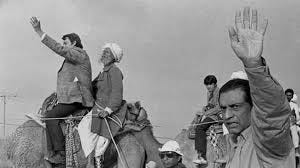
Calcutta was a paradise for Bhai and I partly because of the unfettered access to cinema. At home in Delhi, my parents frowned upon it. Struggling to cope and settle into an alien city they didn’t have time for movies. My father’s work kept him travelling 15-20 days a month. He was a Trade Union leader and member of the Socialist Party. Ma was working for the Indian Customs and writing her thesis on Muslim Politics in Bengal. Nevertheless, they would take us to various cultural programmes going on in the city. All save cinema. I remember seeing only three films with them, Anand (I was too young to understand) Bhuvan Shome when the four of us were the only audience, and strangely enough, Hare Rama Hare Krishna! I think my aunts were visiting and persuaded my parent to go and take us along. That was the last time my parents gave in to cinema request.
I truly believe that if it wasn’t for Calcutta, I might not have become a filmmaker. My Mashimoni, my mother’s sister Ratna, was mad about cinema and would regularly cart us off to see whatever was showing nearby. We would spend part of the holiday with my maternal grandparents. At any given moment there would be 9 of us, at time 12. The mothers, 3-4 of them from the original 6, would huddle together in the corner room, chatting, laughing, drinking endless cups of tea. Child care would be the sole responsibility of Dida, my grandmother. In retrospect I have come to believe that taking us to the movie was a way to give my Dida some breathing time. Perhaps.
But the excitement and romance of cinema gripped me from an early age. The first film I have a more or less clear memory of is Goopy Gayen Bagha Bayen by Satyajit Ray. We saw it several times because we loved it so. Interestingly, even at my paternal grandparent’s house, where cinema was looked down upon, we were taken to see this film. Mr. Ray had lived in the outhouse in our backyard, a charming two storied building. And although he had moved before I was born, my family was fond of pointing to the house and informing every visitor, Satyajit Ray used to live here. Perhaps because it was his film, or because this was the first children’s film, no one objected and we got to see it 3 or 4 times.
We were fewer cousins at my paternal grandparents’ house. Because my father was one of the youngest of 10. We were altogether 5 and we would enact scenes from the movie throughout the weighty, moist afternoons while the adults slept after a heavy lunch. Well, my younger cousin and I didn’t get to act. There were no female roles! I still remember the burning resentment with which I watched. It didn’t occur to me, or my male cousins, that we could play a male role. I was only 6 and Tanuka 4, and we could have done so easily. I suspect the gendered division I faced walked me towards feminist understanding.
But serendipitously Satyajit Ray played a role in my growing up as a cinephile. Each summer, when we reached Calcutta, we would be greeted with two thick tomes, the annual publications of Desh and Anandabazar Patrika, the former a magazine and the latter a daily. One of them carried a novel by Satyajit Ray without fail. The detective, Feluda took me into endless adventures and always caught the villain, and Prof Shonku, the scientist had equally thrilling voyages.
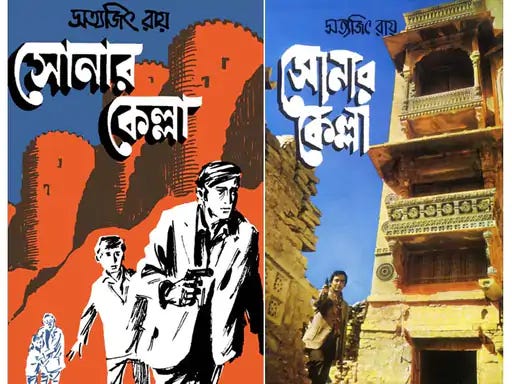
But finally, it was Shonar Kella, the Golden Fort, 1971, that I read with breathless excitement that Ray turned into a movie in 1974, that gave me first understanding of script and screenplay. As a 11 yr old I didn’t understand much but I could see where the movie differed from the novel. I made a list of what all was deleted from the book and what added. How brilliantly the character of Jatayu came to life. I had read that Ray wrote and sketched the character of Feluda based on the actor Soumitra Chatterjee. And I wondered if he did the same for Jatayu who was introduced late into the series and became a permanent fixture.
Today, in Calcutta, the well-known film school is named after Ray, Satyajit Ray Film and Television Institute. Murals, celebrating him, have come up here and there. But the first house he lived in when he moved from his ancestral house lies neglected behind my house, taken over by a religious sect who have no understanding of cinema or music for that matter. Marie Seaton wrote the biography of Satyajit Ray, Portrait of a Director: Satyajit Ray, 1971 while he lived in this house, 31 Lake Avenue. Ray’s early works were conceptualised and actualised here, he found his Apu here. It’s a pity how we neglect our national treasures. Ideally, the house ought to be turned into a museum of memories on the early works of Mr. Ray.
Didn’t know your family’s connection to Satyajit Ray... your anecdotes are memorable.
Such a lively and lovely piece Gargi Ma'am . Thank you for sharing .